Unanswered grievances are
the risk no balance sheet shows
Grievances raised, commitments made, and which ones addressed the root cause — that is the record. TrustDynamics measures the gap, asset by asset, starting with mines and AI data centers.
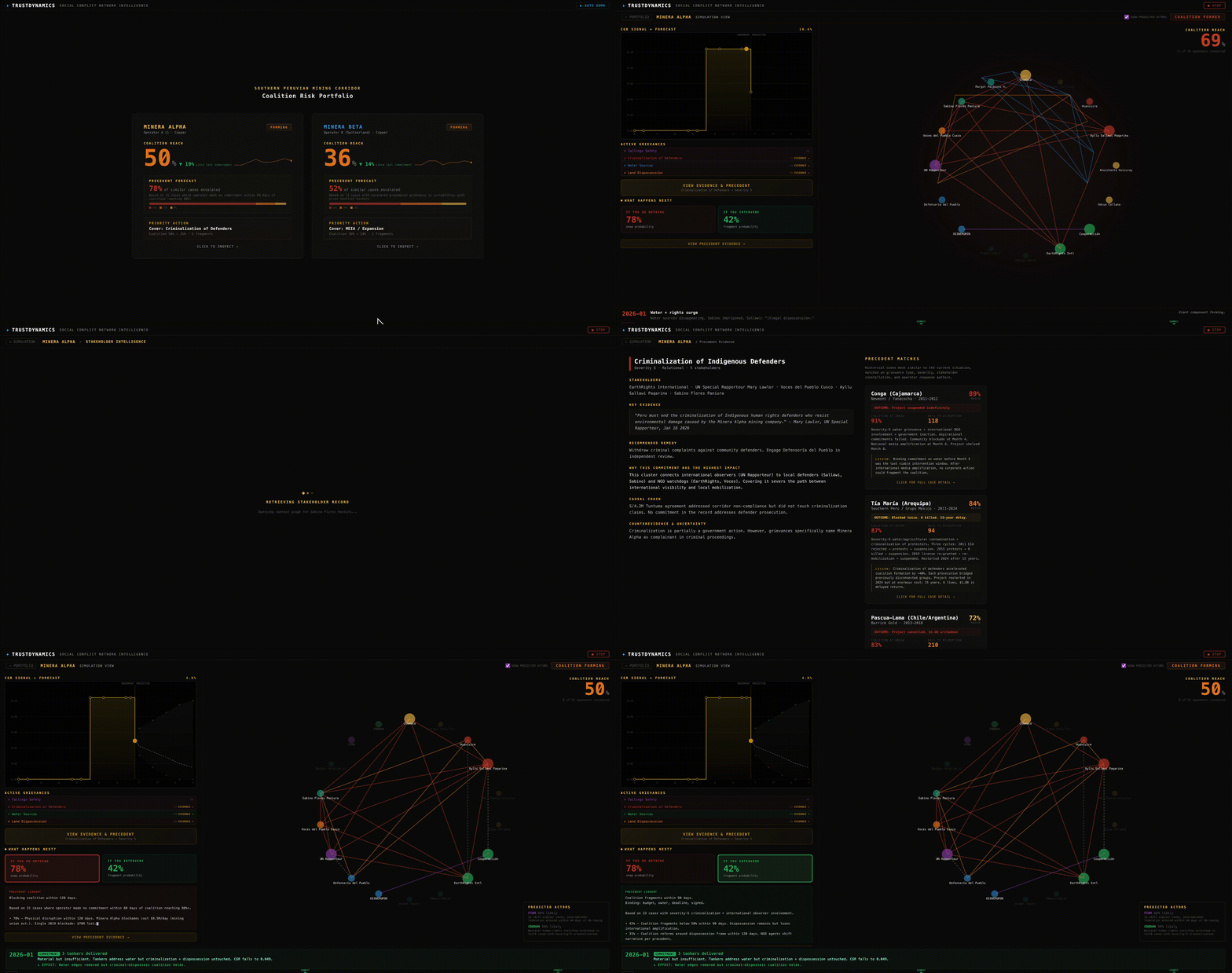
Did the asset answer what communities actually objected to?
The CGR — the commitment–grievance ratio — is the share of recorded grievances that have a verified answer. Not promises, not engagement activity, not money spent. Verified answers to the issues actually driving the risk. Unverified counts as zero: a promise without an owner, funding, and evidence that it happened scores nothing. Grievances answered, divided by grievances raised. Ten commitments on one grievance still answer one grievance. Not every grievance carries equal network consequence; weighting is defined in the methodology.
See the score move.
Public grievances accumulate. Verified answers enter the record. The score changes only when the evidence changes. Reconstructed from three decades of public record in one mining corridor: the assets that entered sustained conflict and suspension were carrying low, flat scores for years beforehand. One never rose above 0.07. The grievances were visible. Verified answers remained scarce.
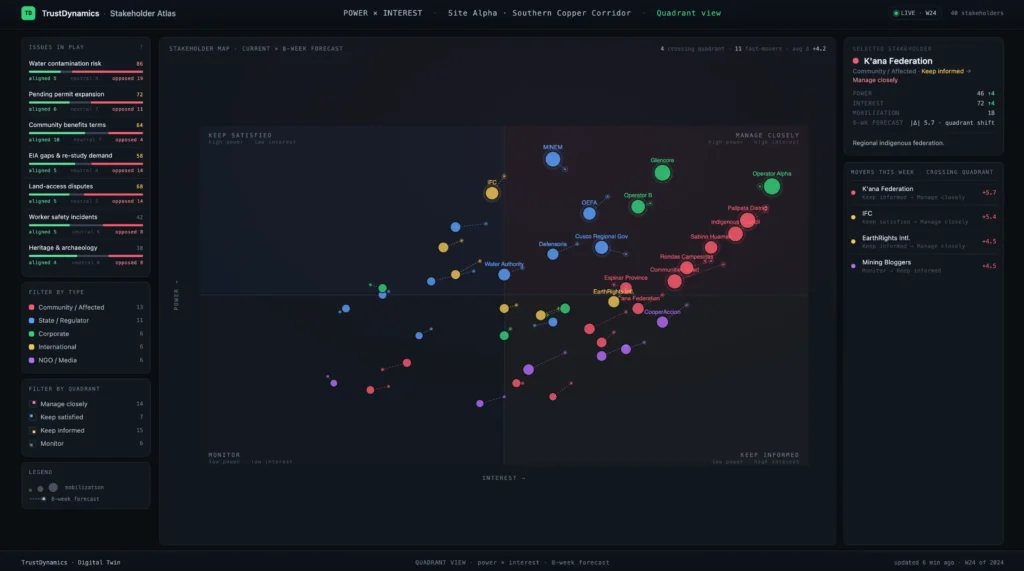
DYNAMIC POWER X INTEREST
Stakeholder maps go stale. Networks move.
Stakeholder maps have always been drawn by hand — expert judgment, refreshed yearly. TrustDynamics computes them from the record, continuously, and tracks whether your engagement moved the needle.
01 Every position traces to specific evidence
02 Defensible to boards and EP4 banks
03 Tracks whether engagement moved the needle
VERIFIED COMMITMENTS
A press release doesn't build trust. Verified delivery does.
Operators spend millions on community programs without knowing what’s landing. Agents check each commitment against the grievance it was meant to answer: Was it funded, completed, and did it reach the root cause? Only what clears all three counts toward the score.
01 Only verified commitments count. Unverified counts as zero.
02 Only answers that reach the root cause hold. Symptoms decay.
03 Dynamic — the score moves as grievances and answers move.
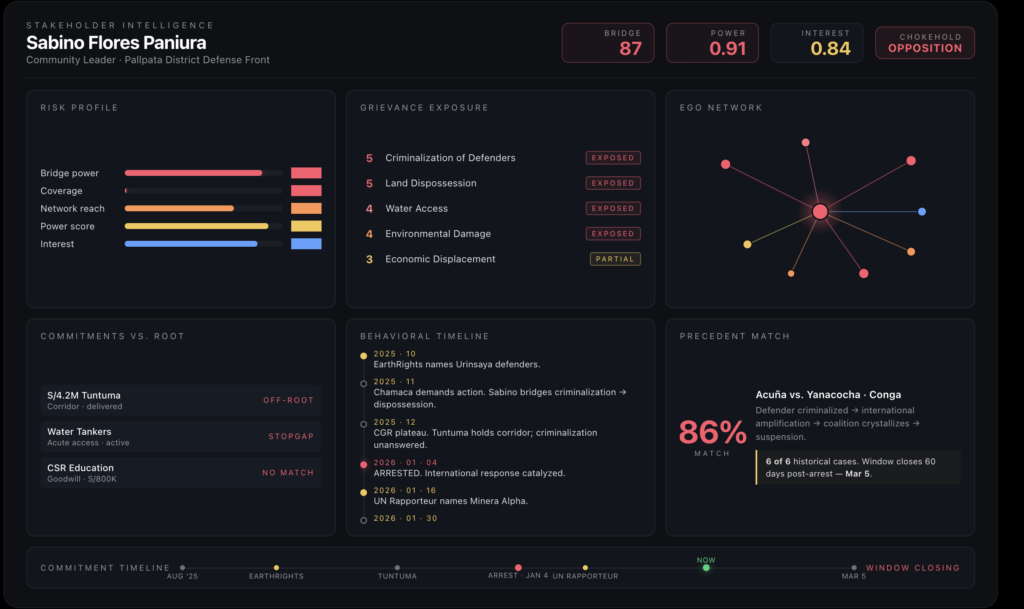
STAKEHOLDER INTELLIGENCE
Misunderstanding the chokeholds can be lethal.
Most grievances stay local. A few actors connect them — to each other, to the capital, to the international press. Those actors decide whether scattered complaints become one coalition.
01 Opposition — Who connects the grievances
02 Distribution — Who bridges local to national
03 Information — Where engagement changes the structure
PRECEDENT LIBRARY
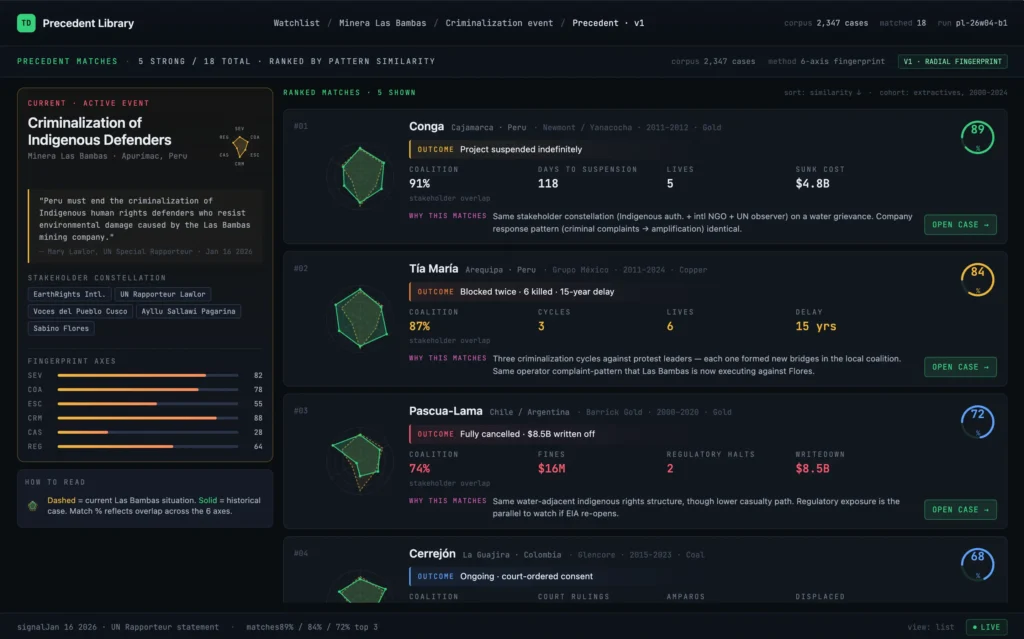
Patterns repeat. The library remembers.
Someone has already faced the situation forming at your asset. Three decades of resolved cases, classified along the seven root-cause externalities, show what held and what collapsed.
01 Evidence based → What held. What collapsed. And why.
02 Matched to sites that looked like yours
03 Every resolved case sharpens the next pattern match
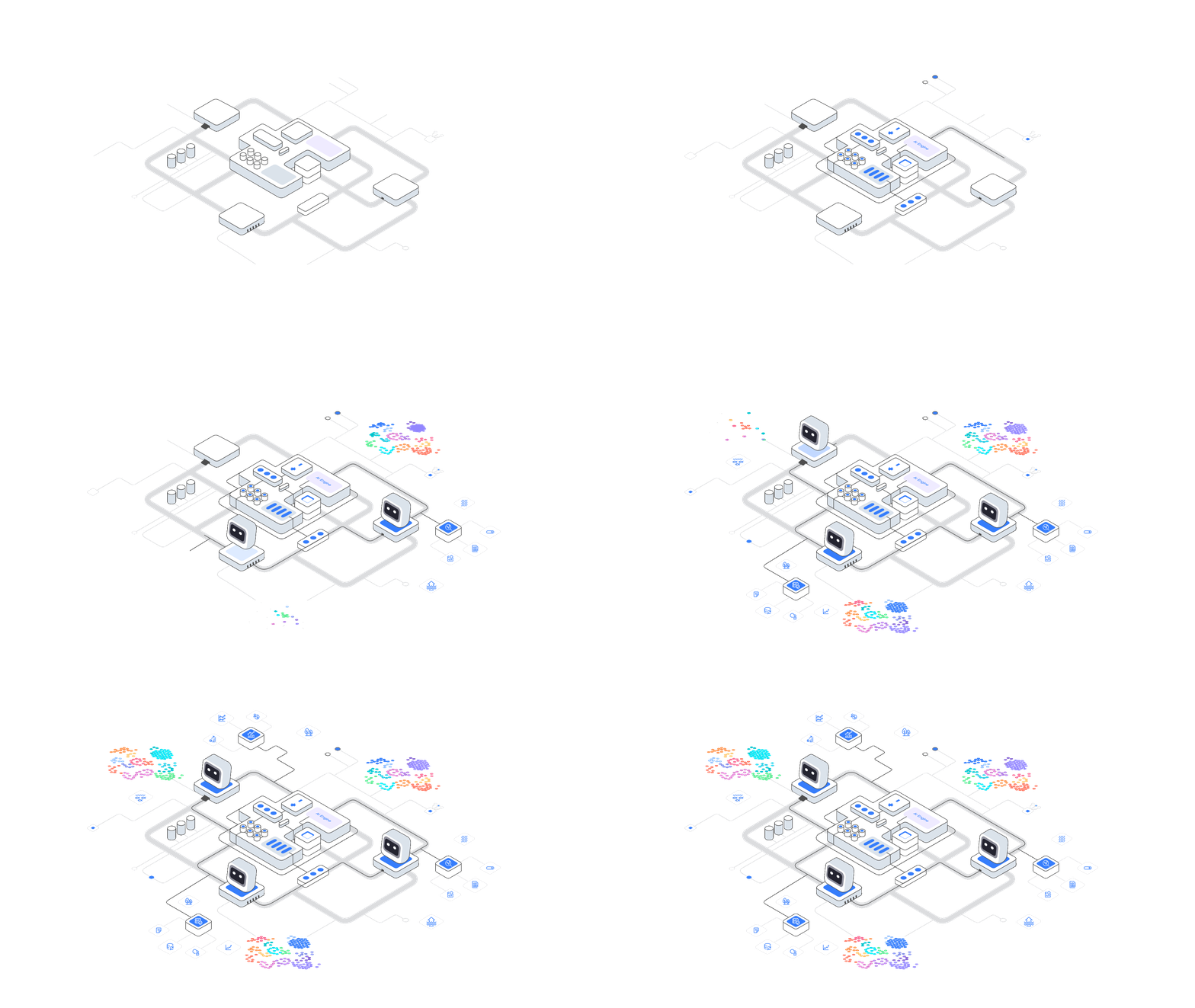
DIGITAL TWIN
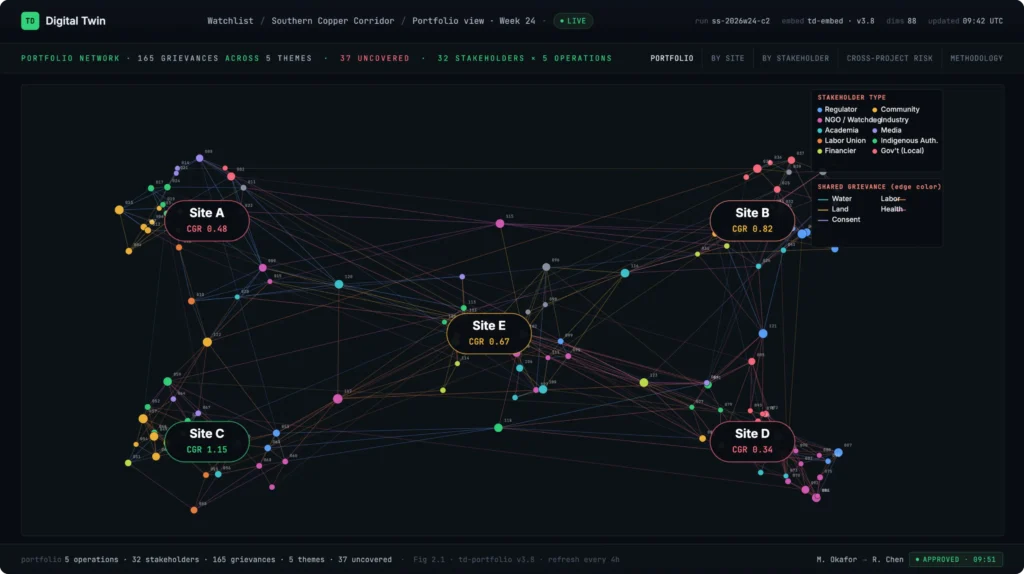
When one community gets something, every surrounding community recalculates expectations.
Risk doesn’t stop at the fence line. Stakeholders, grievances, and expectations flow across every connected project in the region. The Digital Twin maps the full network.
01 Risk does not stop at the fence line
02 An adjacent operator's crisis moves your network
03 Expectations reset across the whole corridor
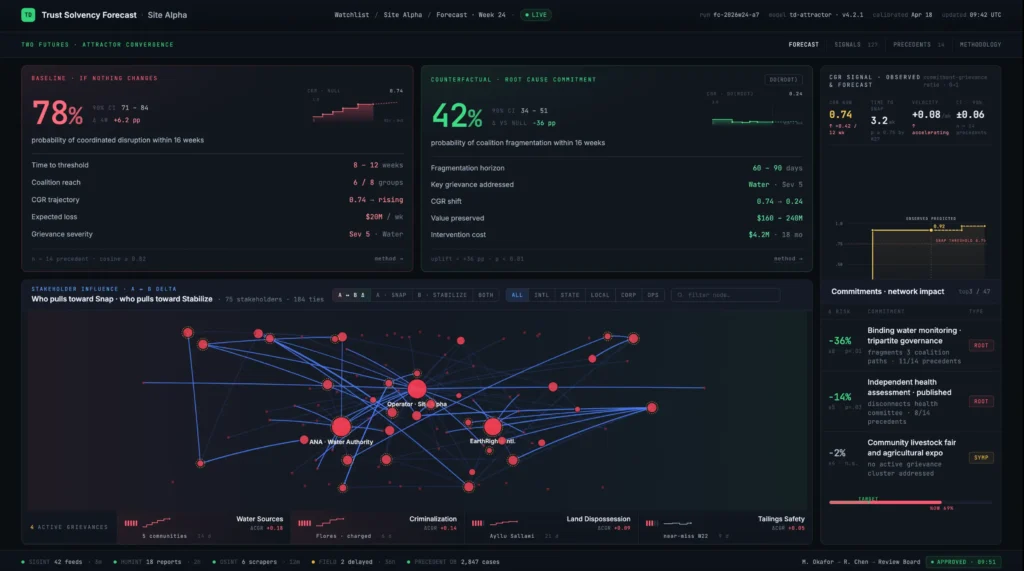
SCENARIOS
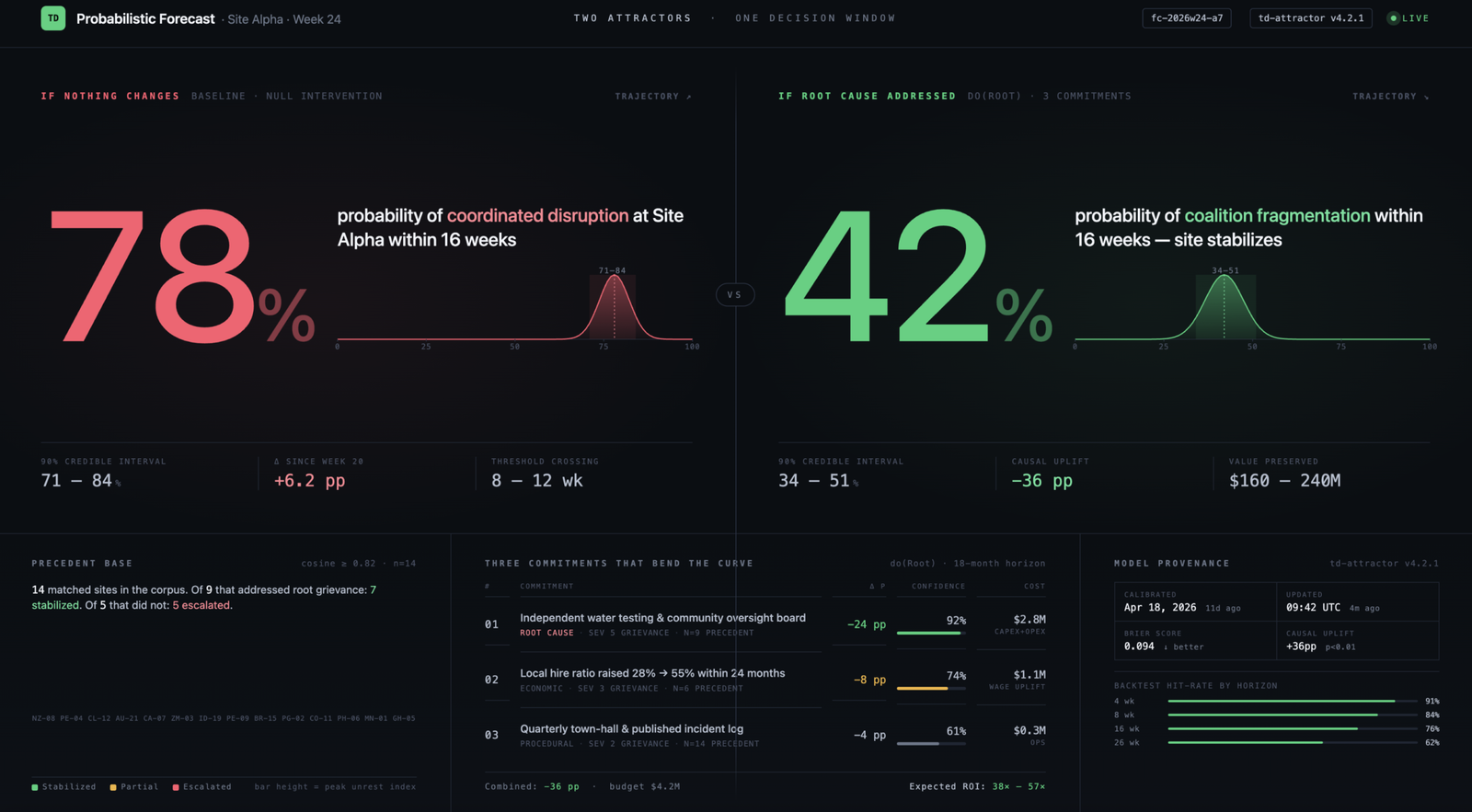
Two futures, grounded in what actually happened.
Every project is being pulled toward shared value or organized opposition. The scenarios show the current trajectory and how different responses compare with resolved cases. Every call is sealed and graded against what happens next.
01 IF NOTHING — where the current trajectory is heading
02 IF COMMIT — how root-cause responses fared before
03 Every call graded. No backfilling.
TRUST, SECURITY & INDEPENDENCE
Salesforce-native
application.
The application inherits the security, permissioning, and compliance layer the world’s largest enterprises have already vetted. Your data stays in your tenant, under your controls. The score is not native to anything a client runs: it computes from public records only, with no port for private inputs — the rated party cannot buy, edit, or supply evidence into its own number.

Making trust measurable
For lenders, insurers, and investors: evaluate social-conflict exposure independently of issuer reporting — an asset-level record the rated party cannot feed. Use it in diligence and monitoring today. As the track record grows, the score can inform pricing, covenants, insurance, and underwriting.

PRODUCT
LEGAL
- Privacy Policy
- Terms of Service